Over the past year of dabbling with large language models (LLMs) and observing the effects of AI in industry, communities and individual people such as myself, I've had these nagging thoughts about how LLMs can cumulatively affect people's thinking and behaviour over time. As people become more embedded in a society with industries and communities that increasingly employ AI in their day-to-day activities, even those that don't use AI will receive spillover effects, not even mentioning those that do actively use AI. In this blog post I will first try to describe how people receive information, then I will try to describe human agency and how these models of information reception and action based on that information can be subverted by AI. Nothing that I have written in this blog post, do I consider as my own original idea. Following writing is an amalgamation of ideas and concepts relating to the nature of man and machine that I attempt to unravel. Reader discretion is advised.
Stereotypes are tools for streamlining received sensory data
Stereotypes get a bad wrap, but they are essential for everyday decision making. Stereotypes are simplified, digestible representations of past lived experiences. In absence of stereotypes, each lived experience must be encountered as a novel phenomenon without generalized reference points derived from past experiences, which becomes exceedingly costly for cognitive processing. Therefore, stereotypes set informing precedent for each new real-life encounter, streamlining intepretation and decision making process, saving energy and cognitive capacity. Thus stereotypes are energy-saving tools that make data interpretation energy efficient as they separate relevant information from background noise and guide the observer through internalized rules-of-thumb, which is termed as heuristics. Stereotypes as a concept could perhaps be considered something akin to autoencoders with added bias.
An autoencoder is a specific type of a neural network, which is mainly designed to encode the input into a compressed and meaningful representation and then decode it back such that the reconstructed input is similar as possible to the original one. [1]
It is debatable if stereotype's purpose is to represent original experience as much as possible, but its proximity to the real-life counterpart it is meant to represent could be contemplated by how many levels of abstraction away it is from its real-life counterpart. This approximation could be termed as degrees of stereotypes. Stereotype that is formed from first hand experience could be designated as a stereotype of first degree, which has the closest relation to something that we could call ‘authentic lived experience.’ We form instinctual assumptions about the world from first hand experiences and rationalizing ideological superstructures upon them with stereotypes acting as building blocks for this ideological worldview, which further informs how we receive and perceive new lived experiences. However, stereotypes are not restricted to the first degree and new stereotypes can be formed from other stereotypes, creating second, third and nth degrees of stereotypes, forming new ideological superstructures further dissociated from ‘lived reality’, or possibly creating a parallel self-referential reality that supplants ’lived reality’ itself.
Aesthetics determine heuristics and heuristics reinforce aesthetics
I consider myself an aesthecisist, meaning that I believe that humans act first and foremost on feelings, which are subtle, physically experienced responses (pleasure, pain, levity, anxiety, etc.) on observer’s internal and external stimuli that leave an implicit or explicit impression. These impressions have a cumulative effect eliciting a certain feelings, that reaffirm, fine-tune or reorient observer’s aesthetic preference. Aesthetic preference could be considered as individuals ‘identity’ or ‘soul,’ that is a sum vector of countless number of multidimensional impressional vectors (MIV) in a multidimensional semantic space, where each vector’s each dimension represents a certain semantic meaning (fig. 1). Every MIV is an input received from outer or inner encounters or experiences to the observer. As these MIVs are combined into a single large vector, it forms that individual’s alignment for certain aesthetic experiences, that is, aesthetic preference, which seeks to reaffirm itself by seeking new inputs, i.e. MIVs, which again directionally align, reaffirm and reinforce established aesthetic preference in the multidimensional semantic space. This process of seeking to reaffirm aesthetic preference could be called aesthetic consolidation.
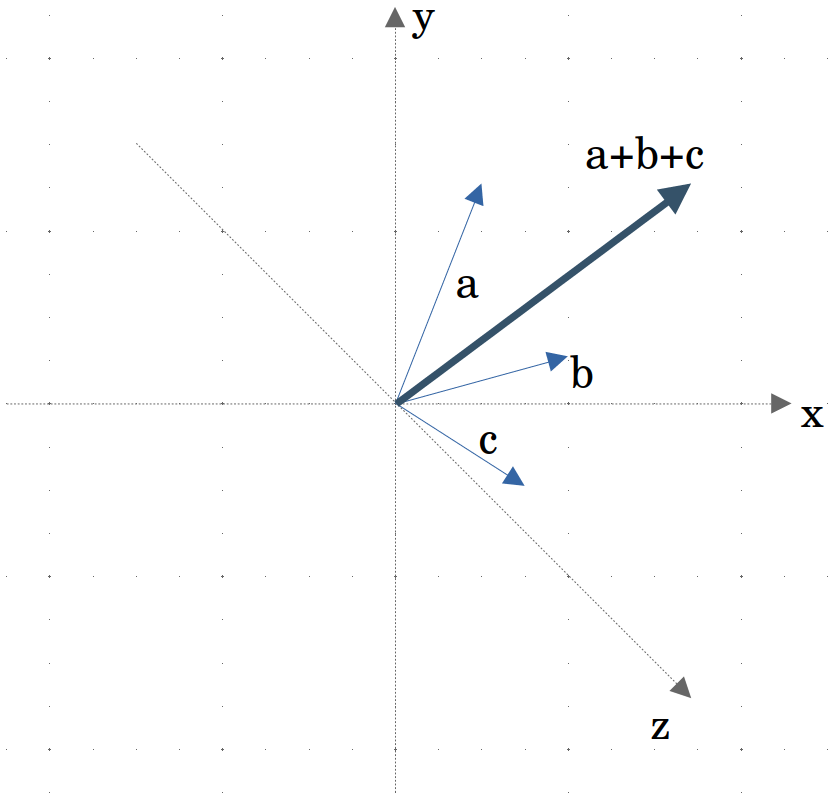
Figure 1: Simplified example of aesthetic preference where multidimensional impressional vectors (MIVs) a, b and c create a sum vector a+b+c, which represents a sum total aesthetic impression (sum vector length) and aesthetic orientation (sum vector direction), that form aesthetic preference, which affects individual’s seeking of new stimuli reception of new impressions and formation of new feelings in the future. Each axis represents certain descriptive semantic concept and its opposite meaning (hot and cold, or soft and hard, etc.). True number of these axis of semantic meaning and MIVs are innumerable.
Therefore, individual’s aesthetic preference and aesthetic consolidation defines his heuristics, that is, his rules-of-thumb for behavior and decision making. And from stimuli are borne impressions from which are borne feelings. And feelings are the force driving the individual to action, because feelings elicit a pushing force from undesired (misaligned) aesthetic experience or a pulling force towards a desired (aligned) aesthetic experience. These feelings-driven pushing and pulling forces are determined by the individual observer’s aesthetic preference, which he wishes to consolidate with and any ‘rational’ thought is for post-hoc rationalization after the decision is already made. This means that human is not rational being per se, but a rationalizing being. Think about it; did you choose to eat healthily and exercise because you decided that these are sensible things to do according to a set of rational principles, or did you choose to eat healthily and exercise because you enjoy to perceive yourself participating in things that are perceived as ‘sensible’ and ‘thoughtful’? Let me rephrase it in another way, any decision that you made, did you do it out of rational deduction, or because it ‘felt right’ and you dressed it up as a rational act after the fact? Did you do virtuous act because you sincerely want to help your fellow man, or because you enjoy perceiving yourself as a ‘hecking good person?’ Now, this isn’t anything new in discussions and debates about ethics, but it is important now and then to ask ourselves about our own true motivating principles that drive us to action; to discern between form and substance.
Aesthetic preference is not set in stone. Hereditary factors contribute to it significantly, but also cultural factors and even occasional traumatic or unprecedented event may radically adjust and realign aesthetic preference. However, aesthetic preference is generally fine-tuned and reinfored by everyday habits, from which the word ethics itself is derived. So when we discuss morality and debate what is ethical, do we end up debating what is habitual or ought to be habitual? But if we focus on analyzing what is, do we eventually unwittingly assume what is as natural and given and therefore as something that ought to be? And conversely, when we describe what ought to be, do we fantasize about it so much that in our mind it is so? Usually in discussion of morality and ethics, the distinction between is and ought get intertwined and lost and maybe they cannot be completely separated, but perhaps aesthetic preference as a concept could at least help elucidate what our ethics is and map it to align to what it ought to be, but which of these should have the priority? That question is beyond the scope of this blog post.
Aesthetic preference doesn't have to model only individual person's identity, but it could also be used to represent human communities' identity. Also, both individual and group identities are more often intertwined than not, either in mutual cooperation or in opposition. Most of us may recall an experience where they said something or acted in a certain way in a social event that ‘soured the mood’ or declared something commonly accepted in that community for which they received smiles and nods of approval. Just as individuals, communities have certain ‘consciousness’ that wishes to reaffirm itself by encouraging certain behavioral expressions in its members and discouraging other actions that doesn’t fit into its ‘vibe’. Those who succeed to align themselves with a community's aesthetic preference are rewarded in accordance to that collective's aesthetic valuation and those that fail to align with community’s aesthetic preference are either reprimanded, shunned or worse. Therefore, the aesthetic preference between individuals and collectives are never separate and both influence, or ‘fine-tune‘, one another. However the degree how much one affects the other on one hand depends on the nature, size and influence of the collective and on the other partaking individual’s status in that community. Think of this as each individual being a ‘node‘ in a ‘neural network‘ of a collective with a certain weight (status in that community) and bias (individual's aesthetic preference).
Phenomena described in previous paragraph could be related to terms of aesthetic alignment and aesthetic misalignment, that represent if two units' (either individual's or collective's) aesthetic preferences share the same direction. This alignment can only be measured by proxy, by either explicit declarations of preference and by actions, but they can never represent true aesthetic preference in satisfacory manner.
Tools reflect our intent as we reflect the tools we use
Often but not always, people think with words and their way of thinking can be affected by the work that they do. An occupation can be described by a certain set of terms, which imprint themselves into a vocabulary as occupational jargon, use of which can bleed over from work to free-time. When a surgeon may think how he could ‘operate‘ and ‘incise through‘ challenging social situation, he thinks with his scalpel, his prime tool of occupational and social identity, like a carpenter thinks how he can ‘chop‘ and ‘carve‘ through his own challenges. The same applies for hobbies, media consumption habits and common conversation partners, where context-specific way of thinking in which used vocabulary is indicator of, imprint themselves into persons general way of thinking. Each action and information exposure as MIVs, fine-tune individual's thinking process and aesthetic preference.
Large language model (LLM) trained with vast amounts of data produced by humans reflects the intent, or more aptly, sum of aesthetic preferences embedded into training data. The neural networks do not understand substance, for they do not think, but only reflect the forms of peoples’ aesthetic preferences. This may introduce a problem of stereotypes dissociated from lived reality; As an unwise king is led astray by flattering advisers, so are even relatively intelligent people drawn into AI-induced psychosis as their digital assistants offer impressions that align with their aesthetic preference in a manner that doesn't necessitate any real-life experiences, nor force any adaptive behavioural changes.
AI chatbot is like a mirror as if one hasn't ever seen one before. As a naive observer smiles at the mirror, it smiles back and as he moves, so the mirror reflects his movements. As the observer raises his eyebrow, so does the mirror and as he jumps, so does the mirror and so on. The mirror is made to reflect and so it repeats everything that the observer does. But what if over time the distinction of initiator and responder become blurred or even switch? If initiator starts to respond to the responder, then responder itself becomes initiator and the situation starts to resemble a case of a tail wagging the dog. Therefore, one could think that the observer himself over time becomes more like the mirror he uses and his own projection, like a digital avatar, is trapped between these two facing mirrors. As the projection of the observer stands between these two opposite mirrors and looks beyond its reflection, it sees nigh infinite tunnel of reflections upon reflections with an alluring visual experience of infinite depth. However, this depth is based on endless self-iterating conjecture, which doesn’t provide any new insight. An endless repetition of references upon itself with each step distancing further from the original source and closer to something less; lack of information, lack of light, one more step away from the first experience, into one more repetition and conjecture without the quality of the original.
Self-referential loops as epistemic traps
What has been said here about stereotypes, preferences and heuristics, now think about it in context of AI use, especially AI chatbots. If humans act even remotely in terms of aesthetic preference as described in this blog post, they are susceptible to self-referencing stereotypes that are many degrees disconnected from ‘lived experience’, just as AIs are susceptible to self-referential loops, depending how they are used. Imagine a model collapse, not only for AI, but for people as well.
Self-awareness and certain precautions are necessary when one intends to utilize AI-tools, since human being’s aesthetic preference can, over time, be influenced by AI-tools into modes of thinking and runaway preference cascades, that set the user into a perspective trap from which it may prove impossible to escape from. A perspective trap that may seem a false reality to outside observer, but is more than real—hyperreal—experience to the affected observer, where simulacrum of self-referential stereotypes are overlaid into lived experience, overriding sensory data to such a degree that no agreement can ever be made about in-real-life observed phenomenon with another aesthetically misaligned person. But surely I, the sensible individual, would never fall in such a trap! No mistake should be made what AI-tools are, that they are just made to effectively reflect our desires back to ourselves and therefore should, with discernment, be delegated to well narrowed down tasks, which can be reliably observed and measured without excessive personal emotional investment.
Plans for the future: mapping aesthetic preference
Best known example of mapping aesthetic preference in a population are surveys, with a set number of questions presented to a selected population. Such surveys, both on individual and collective level present their own kind of problems in terms of human psychology, that is, the problem of unreliable respondent and the problem of unreliable surveyor. In economics, it is well known that consumers' declared preference and revealed preference can be radically different. Think of this as wave–particle duality, but replace electrons with people. Therefore, I think that by discreetly observing, won't eliminate but would at least mitigate the problem of unreliable respondent and map aesthetic preference into a observable metric using Word2Vec.